22 October 2026


Market
From master to disc: how vinyl pressing actually works
Vinyl has been back in the mainstream conversation for years now, but the process behind it remains largely a black box even to people who work in music professionally. A record label manager can commission a pressing, approve artwork, and pick a vinyl weight without ever seeing what happens between “the album is mastered” and “the boxes arrive at the warehouse.” Here’s what really happens in between.
From audio file to cutting master
The process doesn’t start with the same master used for streaming or CD. Vinyl is a physical, mechanical medium: a stylus has to physically track a groove, which means the audio going into that groove has to be prepared with the medium’s limits in mind – controlled low-end (typically summed to mono to prevent the needle jumping the groove), managed dynamic range, and attention to how sibilance and high frequencies will translate once they’re cut into a physical wall of vinyl rather than played back digitally. A mastering engineer working specifically for vinyl adjusts for all of this before the audio ever reaches a cutting lathe. Skipping this step, or using a streaming master as-is, is one of the most common reasons a pressed record doesn’t sound the way an artist expected.
Cutting: the lacquer and the groove
Once a vinyl-ready master exists, it becomes a physical groove. In traditional cutting, the audio is transferred onto a lacquer-coated aluminium disc using a cutting lathe: a heated stylus, driven by the audio signal, carves a continuous spiral groove into the lacquer in real time as the disc rotates. The depth and width of that groove, and the distance between grooves, directly determine playback volume and how much music can fit on a side, which is why loud, bass-heavy records often mean shorter sides.
There’s also an alternative to lacquer cutting: DMM, or Direct Metal Mastering, which cuts the audio straight onto a copper-coated disc instead of lacquer. DMM tends to deliver sharper high-frequency detail and less pre-echo (the faint pre-hearing of a loud passage in the groove before it), while lacquer cutting is still the more widely used method and is generally associated with a warmer character. Neither is objectively “better”, the choice is about what suits the material.
Electroplating: from lacquer to metal stamper
A cut lacquer is playable, but it’s also fragile, it can’t survive being pressed against thousands of records. To turn it into something durable enough for mass production, it goes through electroplating, also known as galvanic processing: the lacquer is coated in a thin layer of metal that captures every detail of the groove with extreme precision. Peeled away, that metal shell becomes the “father.” From the father, a “mother” is grown, and from the mother, one or more “stampers”: the actual metal plates that will press the groove pattern into vinyl. Working from stampers rather than directly from the lacquer means a title can be repressed later without having to re-cut it from scratch, as long as the stampers or mothers are preserved.
Pressing: where our production takes over
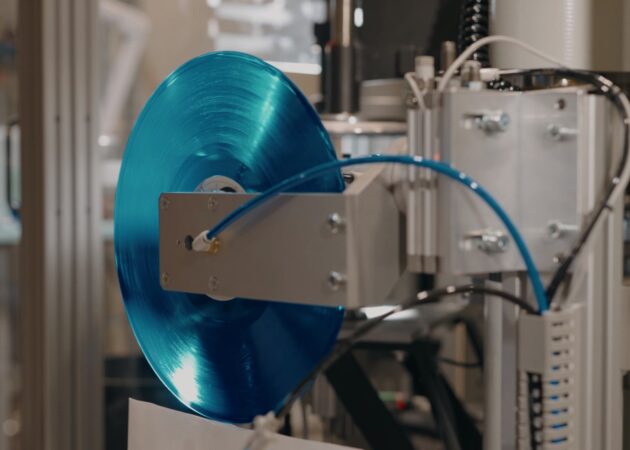
This is the stage where Pozzoli’s own production floor takes over. A stamper is mounted into a hydraulic press alongside its counterpart for the opposite side of the record. A heated puck of PVC is placed between the two stampers, along with the pre-printed labels. Under heat and several tons of pressure, the press flattens the puck outwards until it fills the moulds completely, with the stampers’ grooves imprinted into both sides simultaneously and the labels fused directly into the vinyl. After a short cooling period, the disc is trimmed of excess material around the edge and released from the press.
At that point the disc is fully formed, but it still needs a couple of days to rest and cool down completely before moving to the next stage.
From disc to finished product
A freshly pressed record still needs to become a finished, shippable product. Each disc goes through visual and playback inspection before being sleeved, assembled into its packaging, and prepared for shipment, whether that’s a simple printed inner sleeve, a spined sleeve, a gatefold jacket, or a multi-format box set built around the release. This is also where quality control checks come in: verifying that the pressing is free of defects, that labels are correctly centred and aligned, and that the finished package matches the specification the release was ordered to.
Why this matters if you’re commissioning a pressing
None of this is trivia. Knowing where a vinyl mastering choice matters, why a DMM or lacquer cut might sound different, or why stampers get preserved for future reorders, changes the questions worth asking a pressing plant before committing to a release and helps set realistic expectations for both sound and timeline. If you’re planning a pressing and want to talk through the specifics for your project, get in touch and we’ll walk through it together.
Pozzoli and the Vinyl Alliance
Pozzoli is a member of the Vinyl Alliance, the international association that brings together the entire vinyl supply chain, from record labels to pressing plants and retailers, to work together on the quality, education and sustainability of the format.